Posts

Detect missed executions with OpenNMS

Image
Everyone knows that OpenNMS is a powerful monitoring solution, but not everyone knows that since version 1.10 circa it embeds the Drools rule processing engine. Drools programs can then be used to extend the event handling logic in new and powerful ways. The following example shows how OpenNMS can be extended to detect missed executions for recurring activities like backups or scheduled jobs.

9 months with WIFIWEB

Image
WIFIWEb is a local WDSL internet provider. Since I moved last year I have been a customer with their WDSL Max 10 profile . This is the pingdom report for the last 9 months: Applications sensitive to latency and micro-interruptions (like Remote Desktop) would from time to time drop the connection. Bandwidth-wise results varied over the period, but except for one time when I had to call to fix a performance issue, the experience was pretty smooth with a download speed consistently in a 6~8 Mb/s window. The 1Mb upload speed was always achieved. Call quality using free VOIP softphones (sflphone or linphone) was generally bad, but I dont't know how much the fault lies with software or the connection. Verdict: recommended.

RUNDECK job maintenance

Image
Learn more about Rundeck . Now that I have a fair number of jobs scheduled by Rundeck, how do I periodically prune the job execution history and keep only the last, say, 30 executions for each job?

OpenNMS performance: tune Jrobin RRD file strategy

Image
One of the nice aspects of OpenNMS is that, out of the box, it will collect a lot of data from most snmp-enabled resources. The downside is that such collection is I/O heavy (iops, not throughput). Even on moderate installations with hundreds of nodes it is enough to swamp even the fastest disk subsystem (except for those with controllers supported by large write caches). A symptom is that I/O wait will be quite high on the opennms box itself. I/O Wait before and after switch jrobin backend from FILE to MNIO

OpenNMS 15: warm your postgres cache

OpenNMS 15 puts a much higher load on the database than previous versions. Besides tuning postgres, the OS and perhaps splitting the app and the db on different boxes one aspect that I found to really make a difference is having a warm postgres cache.

Auto-upload Elastisearch template mapping with Apache Camel

Image
When feeding data into Elastisearch, one important step is to configure the correct template for the index/type so that, for instance, numeric fields are stored as numbers to ensure that they can be sorted by and/or confronted correctly. The Elasticsearch Logstash plugin has a handy option just for this purpose. If you are not using Logstash you have to do it yourself, eithr through configuration mgmt, startup scripts or simply manaully launching the appropriate curl command. If you have followed my previous post on using Apache Camel to feed sql data into Elasticsearch then it might come natural to attempt to use Camel also for the purpose of uploading the template mapping.

Camel-Elasticsearch: create timestamped indices

One nice feature of the logstash-elasticsearch integration is that, by default, logstash will use timestamped indices when feeding data to elasticsearch. This means that yesterday's data is in a separate index from today's data and from each other day's data, simplifying index management. For instance, suppose you only want to keep the last 30 days: elasticsearch-remove-old-indices.sh -i 30 The Apache Camel Elasticsearch component provides no such feature out of the box, but luckily it is quite easy to implement (when you know what to do.  /grin ).

Extending a LVM logical volume with SaltStack

Image
How do you, at once, extend a LVM logical volume on a fleet of identical linux ( Centos ) servers using SaltStack ? Here's how and, thanks to Salt, it only took 5m.

Indexing Apache access logs with ELK (Elasticsearch+Logstash+Kibana)

Image
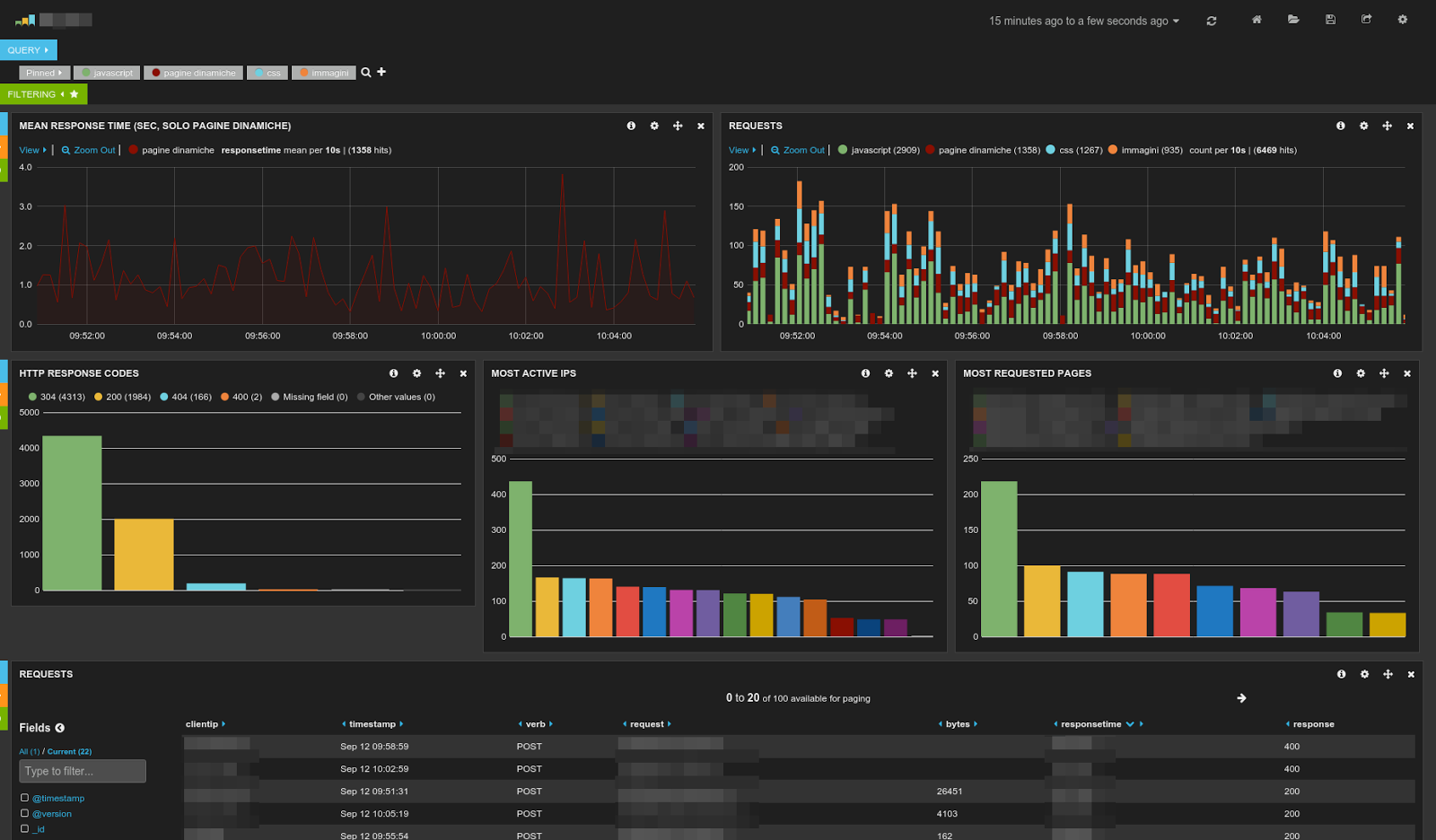
Who said that grepping Apache logs has to be boring? Sample of dashboard that can be created with ELK. Pretty impressive, huh? The truth is that, as Enteprise applications move to the browser too, Apache access logs are a gold mine, it does not matter what your role is: developer, support or sysadmin. If you are not mining them you are most likely missing out a ton of information and, probably, making the wrong decisions. ELK (Elasticsearch, Logstash, Kibana) is a terrific, Open Source stack for visually analyzing Apache (or nginx) logs (but also any other timestamped data).

Extract TABLE data from a large postgres SQL dump (with postgis)

What do you do when postgres refuses to import a dump because it contains invalid byte sequences? Solution: feed the sql script to iconv then import it as usual. That's easier said than done especially if your database contains postgis data which must be restored through a custom postgres dump (instructions here ). I recently experienced this issue on a relatively small table in a large-ish database. Since hand editing the SQL dump is cumbersome and hard (it is over 500MB in size) the only and most elegant alternative was to do it with a script. The following is an awk script which will extract the COPY instructions relative to a table from a postgres SQL dump: File: copy_estract.awk ---------------------- BEGIN {start=0} /^COPY "/ { if(index($0,TBL)!=0) { start=1; } } // {if(start==1) print $0;} /\\\./ {start=0;} Usage: awk -f copy_extract.awk -v TBL=TABLENAME pgdump/database_dump.sql One liner: awk -f copy_extract.awk -v TBL=TEST pgdump/d...

Ehcache: deploy multiple versions of a Grails app (fix javax.management.InstanceAlreadyExistsException)

When a Grails application makes use of the Ehcache cache plugin in its default configuration it can be impossibile to perform deploys of multiple versions of the app, even though the container might support it. The same plugin (in its default configuration) also breaks deploying multiple different Grails apps on the same container. The problem is in the way the plugin generates the name for the cache (which will then be used to register the cache jmx bean): the name is by default set grails-cache-ehcache . When another second application or another application version is deployed registration will fail because the name already exists. The exception message is the following (indented for clarity): org.springframework.beans.factory.BeanCreationException: Error creating bean with name 'ehCacheManagementService': Invocation of init method failed; nested exception is net.sf.ehcache.CacheException: javax.management.InstanceAlreadyExistsException: net.sf.ehcache:type=CacheM...

Create an OpenLayers map programmatically

Sometimes it is useful to abstract away the repetitive layer creation code with a configuration-based approach. For example consider this very simple map taken from the OpenLayers examples : How could we avoid repeating invoking the layer contructor and instead provde a framework that allows us to instantiate any layer with just configuration? The solution is quite simple.

Book review: Sproutcore Web Application Development

Image
TL;DR:  Sproutcore is a huge framework, and this book will save you a lot of time (and headaches). Buy it. Disclaimer : this is a review of a free copy that Packt kindly sent me. Win a free copy of this book, scroll down to know how to participate! If only I had this book 3 years ago! 3 years ago I started developing a Sproutcore app as a learning experience and, in all honesty, the path has been rough. Sproutcore is a massive  framework with lots of features: some are well documented, some mentioned casually in the guides, some others...well you don't know they are there until you start reading the code or chat with one of the more knowledgeable devs in IRC.

Easy animations with Sproutcore 1.10

The release of Sproutcore 1.10  marks an important step in the life of this very popular framework. Lots of new features make developing applications on the Sproutcore framework even easier and fun. One improvement that I am sure will catch your eye (pun intended) is  view animations . Coding view animations was rather easy also on previous versions, but with 1.10 animations are now first class citizens bolted into the core rendering subsystem. For an example of what is available out of the box see this  demo . So how would you use this goodness in an actual Sproutcore application? And how much code would it take? As an example I have put together a very basic Sproutcore app ( source , demo ) which has two states: an authentication form and a main screen. Logging in transitions the app from the login form to the main screen and logging out returns the app to the login screen. Pretty simple.

Manage Windows printer event log settings from command line (i.e. GPO scripts)

Image
Just a quick note to self that to enable/disable/query event log registration from the command line on Windows releases greater than XP and Server 2003 you can use the wevutil tool. For example to enable logging of print requests on Windows 7 for auditing purposes: wevtutil sl Microsoft-Windows-PrintService/Operational /e:true The equivalent command for the the above on Windows XP is the following: reg add HKEY_LOCAL_MACHINE\SYSTEM\CurrentControlSet\Control\Print\Providers /v EventLog /t REG_DWORD /d 7 /f net stop spooler net start spooler

Developing Sproutcore apps on c9.io

Image
The Cloud9 online IDE running on Chrome/Mac. Today I was looking for a way to quickly edit a pull request to the Sproutcore project without booting up my laptop, but using the MacMini in the living room instead, which is always on, being our main entertainment system. Turns out it's quite easy if you do not mind signing in into another online service: the  Cloud9 online IDE .

Book Review: Instant OpenNMS Starter

Image
Disclaimer: Packt kindly sent me a free copy for review. TL;DR: Rating 4/5. Recommended for beginners and intermediate. The book itself is short, but packed with information. A fast reader with some experience with OpenNMS should be able to finish it in 4 to 6 hours. Beginners will probably want to follow the pointers to the online documentation, check the configuration files and possibly experiment so they should allocate more time. Before being published the book has been reviewed by Jeff Gehlbach. Anyone who has been involved with OpenNMS for some time know him, as he is one of the many brilliant minds working for the OpenNMS company, the commercial entity which develops and supports OpenNMS. Surely his involvement serves as a kind of seal of quality for the book. I for one was surprised by the clarity with even the most complex aspects of OpenNMS were presented in such a short text. Instant OpenNMS Starter is divided in three main parts: installation, quick start...

Monitoring Oracle tablespace quota with OpenNMS

Image
Going beyond the normal application availability check One interesting use of the  OpenNMS JDBC poller is for extracting data from the Oracle administrative database tables, for example tracking tablespace quota usage to detect quota exhaustion, sudden usage peaks and graph usage over time. Graph of quota usage for user [redacted] on tablespace DAT. Notice the cleaning operation running at 3.30 AM Tablespace quotas is a feature present in the Oracle database that allows the DBA to set a limit on the amount of storage that any given user can consume on a specific tablespace. This allows the DBA to share tablespaces across users yet still be able to policy users into predefined usage boundaries. When a user consumes all its quota it can no longer store data, but it can delete it, thus allowing self-recovery.

A not so short guide to ZFS on Linux

Image
Updated Oct 16 2013: shadow copies, memory settings and links for further learning. Updated Nov 15 2013: shadow copies example, samba tuning. Unless you've been living under a rock you should have by now heard many stories about how awesome ZFS is and the many ways it can help with saving your bacon . The downside is that ZFS is not available (natively) for Linux because the CDDL license under which it is released is incompatible with the GPL. Assuming you are not interested in converting to one of the many Illumos distributions or FreeBSD this guide might serve you as a starting point if you are attracted  by ZFS features but are reluctant to try it out on production systems. Basically in this post I note down both the tought process and the actual commands for implementing a fileserver for a small office. The fileserver will run as a virtual machine in a large ESXi host and use ZFS as the filesystem for shared data.

Development is fun again with nodejs

Image
Being a longtime Java developer, back from when servlets where cool and Struts was making MVC popular among web devs, I always try to find new and more productive ways to deliver software within the Java ecosystem. Recently I turned to Grails and delivered several projects with it. When developing with Grails you can use the power and the expressiveness of Groovy to write compact, elegant, fluent and readable code. The downside is that Grails is huge: even the most simple Grails apps will weigh in the 40MB range compilation, test and building takes a long time (minutes, actually) even in recent versions it is (fairly) complex, but that I can understand because it does so much it will consume a huge chunk of you app server memory when deployed I have been using Grails as the backend for  Mappu  too, initially just because I wanted to bootstrap the project quickly and Grails is simply perfect for that. But as time passed I started to find Grails too heavy for a sim...